


Jump & pounce
A well-timed landing on a creature is your first line of defense. Many enemies can be pounced on; spikes and other hazards demand a different plan.
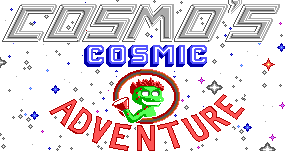
A little green alien. A very big adventure.
A whole planet worth getting stuck on.


Before double jumps became second nature, Cosmo had a better idea: stick to the wall.
Released by Apogee Software in March 1992, Cosmo's Cosmic Adventure is a side-scrolling MS-DOS platformer starring a green, red-spotted alien with suction cups for hands. Thirty main levels across three episodes turn an unexpected stopover into a rescue mission.
It's a world of enormous trees, grinning monsters, peculiar fruit, and machinery that probably hasn't passed an inspection. Its 16-color EGA graphics are full of personality. Episode 1 circulated as shareware; the other two adventures came with the registered game.
How a birthday trip went sideways
Cosmo and his parents are headed to Disney World for his birthday when a comet hits their ship. An emergency landing leaves the family on an uncharted planet.
While his dad works on repairs, Cosmo slips away to explore. An hour later, he comes back to an empty landing site. His parents are missing. In their place: enormous, alarming footprints.
Convinced something terrible has happened, our small explorer follows the trail. The planet has more than a few surprises in store.
From the original in-game story
 01 · Find a wall
Jump toward a suitable wall and Cosmo grabs it with his suction-cup hands. From that grip, jump away and steer back to attach a little higher. Repeat, and a sheer cliff becomes a staircase.
That changes how you read a level. The route isn't just the ground in front of you: it's the wall beside you, the ledge above, and that suspicious pocket of fruit just off-screen. Looking up and down helps reveal what the camera isn't showing.
 Field tip: Ice and other slippery surfaces can spoil your grip. Find a different route.
A well-timed landing on a creature is your first line of defense. Many enemies can be pounced on; spikes and other hazards demand a different plan.

Carry up to nine bombs. Plant one, then get clear of its delayed explosion. Bombs can dispatch enemies and break obstacles, but the blast can hurt Cosmo too.

Start with three health cells. Power-up modules restore one unit. A hidden hamburger adds an empty cell, up to five; find another module to fill it.
Stars unlock bonus stages when you collect enough. Fruit and other prizes build your score. Secret passages reward the player who checks every nook.
 Switches
Head switches open matching doors; foot switches activate parts of the level.
 Springs
A boost from below sends you higher than a regular jump.
 Hover pods & platforms
Ride across a gap or travel with a moving platform. Timing matters.
 Teleporters
Step into a transporter to reappear elsewhere in the level.
Hint stationsTouch a hint globe for advice about the strange things around you.
 Hazards
Watch for spikes, saws, crushers, slippery ice, and bottomless pits.

The same little alien. Increasingly strange surroundings. Choose an episode to explore.

Blue skies and mountains give way to dense forest, a thunderstorm, steep underground climbs, icy caverns, and rock-mounted machinery. Even the first adventure keeps changing its visual vocabulary.
The early open landscapes teach you to read walls as routes. Later maps become taller, asking you to climb through the scenery instead of simply running across it. Moving platforms join the mix in the mechanical areas.
Some bite. Some bounce. Some are surprisingly helpful. Open a field note for a closer look.
No creatures found. Try another name or habitat.
Names are descriptive fan labels, not an official Apogee taxonomy. See Cosmodoc's sprite reference and the reconstructed game code.
Programmed by Todd Replogle · Level design by Todd Replogle · Level editor by Allen H. Blum III · Graphics by Stephen Hornback · Music by Robert Prince.

Episode 1 is the original freely distributable shareware. Start exploring in your browser, or grab the DOS archive and take it for a spin in DOSBox.
Original Episode 1 v1.20 · Complete, unmodified shareware ZIP.
Episodes 2 and 3 were part of the registered release.
Destination:
Somewhere worth exploring.
Cosmo and all original game artwork belong to their respective rights holders. This is an independent, unofficial celebration of the game.
The sprites, title graphics, and Episode 1 environments here were decoded from the original shareware data. Thanks to Scott Smitelli's Cosmodoc and the ModdingWiki contributors for documenting the formats.
Asset credits & research sources


